The Impact of Roasting on Low-Acid Coffee Flavor Profiles
Roasting is not just a step in making coffee -- it is the step that determines everything. The acidity of your cup, the antioxidant content of your brew, and whether coffee causes heartburn or feels gentle on your stomach are all set during the roasting process. Not by bean selection. Not by origin. Not by brew method. By roasting. This is the chemistry that Puroast has mastered -- and patented -- through 40+ years of traditional roasting science.
70%
Less acid than leading brands -- set entirely by roasting
5X
More antioxidants -- converted from acids by traditional roasting
pH 5.7+
Above the critical 5.5 threshold -- independently verified
1 of 7
Only Puroast passed NC A&T's independent pH verification
The Most Common Roasting Myth: Simply roasting darker does NOT make coffee genuinely low acid. A 2024 NC A&T State University study independently tested 7 brands all claiming to be low acid -- including multiple dark roast brands. Six of the seven tested as acidic as or more acidic than regular commercial coffee. Only Puroast passed. Flash roasting -- no matter how dark -- cannot replicate what traditional roasting achieves through fundamentally different time-temperature chemistry.
Shop Puroast -- The Science-Backed Roast
Every Puroast roast is made with the same patented traditional process -- independently verified low acid, 5X more antioxidants, zero additives.

Italian Espresso Roast
Dark Roast - Ground - 2.5 LB
Shop Now

Dark French Roast
Dark Roast - Ground - 2.5 LB
Shop Now

Ugandan Single Origin
Medium Roast - Ground - 2.5 LB - Most Select Bean
Shop Now
The Chemistry of Roasting: What Actually Changes in the Bean
When green coffee beans are exposed to heat, a cascade of chemical reactions begins. The most important of these -- for both flavor and health -- is the conversion of chlorogenic acids (specifically dichloroquinic acids) into other compounds. Dichloroquinic acids are the bitter, stomach-irritating compounds responsible for heartburn and acid reflux in regular coffee drinkers.
In conventional flash roasting -- the industrial standard used by virtually all commercial coffee brands -- beans are exposed to extremely high heat for a very short time. This process does not eliminate dichloroquinic acids. It preserves and concentrates them.
Traditional roasting -- the process Puroast uses -- works on a fundamentally different time-temperature curve. Lower heat sustained over a longer period drives the complete conversion of dichloroquinic acids into phenolic compounds: potent antioxidants that are both healthful and flavor-positive. A landmark 2008 peer-reviewed study by UC Davis Professor Dr. Taka Shibamoto confirmed this chemistry -- Puroast's traditional roasting process converts acids into antioxidants rather than preserving them, producing a coffee simultaneously lower in acid and higher in antioxidant content than any conventionally roasted coffee tested.
Traditional Roasting vs. Flash Roasting: The Critical Difference
Flash Roasting (Industry Standard)
- High heat (450-480 degrees F) for short time (8-12 minutes)
- Dichloroquinic acids preserved and concentrated
- pH typically 4.85-5.2 -- highly acidic
- Lower antioxidant content
- Produces bitter, harsh flavor compounds
- Commonly causes heartburn and acid reflux
- Used by virtually all commercial brands
Traditional Roasting (Puroast Process)
- Lower heat sustained over longer time
- Dichloroquinic acids fully converted into phenolic antioxidants
- pH 5.7+ -- above the 5.5 low acid threshold
- 5X more antioxidants than other leading coffees
- Produces smooth, rich, complex flavor
- Dramatically gentler on the stomach
- Patented process -- only Puroast uses it
How Roast Level Affects Flavor Profile
| Roast Level |
Conventional Flash Roasted |
Puroast Traditional Roast |
| Light Roast |
Bright, acidic, fruity -- pH 4.85-5.0. Highest dichloroquinic acid concentration. |
N/A -- Puroast focuses on medium and dark roasts where traditional chemistry is most impactful. |
| Medium Roast |
Balanced but still acidic -- pH 4.9-5.1. Acids partially developed. |
Smooth, balanced, complex -- pH 5.7+. Acids fully converted. Best expression of bean character. Ugandan Single Origin, House Blend, Colombian Supremo. |
| Dark Roast |
Bold, bitter -- still pH 4.9-5.2 despite darker color. Flash roasting does NOT achieve low acid. |
Bold, rich, smooth -- pH 5.7+. No bitterness from dichloroquinic acids. Dark French Roast, Italian Espresso Roast, French Roast Pods. |
The NC A&T Study: Proof That Roasting Method Determines Acidity
In 2024, NC A&T State University published an independent study that tested 7 coffee brands all claiming to be low acid. Multiple dark roast brands were included. The results were clear: six of the seven brands -- including dark roasts -- tested at pH levels indistinguishable from regular commercial coffee. Only Puroast tested above the pH 5.5 threshold.
This study is the definitive evidence that roast darkness is not the determining factor. Roasting process is. You cannot achieve genuine low acid coffee by simply roasting longer or darker with flash roasting equipment. The fundamental chemistry must be different -- and only Puroast's patented traditional roasting process achieves that difference.

House Blend
Medium Roast - Ground - 2.5 LB
Shop Now

Mocha Java
Medium Roast - Ground - 2.5 LB
Shop Now

Bourbon Pecan Torte
Medium Roast - Flavored - Ground - 2.5 LB
Shop Now
Puroast's Patented Roasting Process: The Story Behind the Science
Puroast's founder Kerry Sachs discovered traditional roasting in the Venezuelan Andes, where local farmers had been roasting coffee this way for generations. Coffee roasted slowly over a biomass furnace -- with patient, extended heat -- produced a cup unlike anything he had ever tasted: smooth, complex, and completely free of the harshness of industrial coffee.
Together they built Puroast around this discovery -- brought the process to California in the early 1990s, starting with health-conscious co-ops, and built a 40-year business on a single principle: patience in roasting produces genuinely better, genuinely healthier coffee. The process is now protected by a United States patent and validated by UC Davis and NC A&T. All Puroast varieties -- from House Blend to Ugandan Single Origin -- are roasted with exactly this process.
What Puroast's Roasting Means for Your Cup: Flavor Profiles
When bitter acids are converted into antioxidants during roasting, the flavor that remains is fundamentally richer, smoother, and more complex. Here's how Puroast's main varieties taste as a result:
-
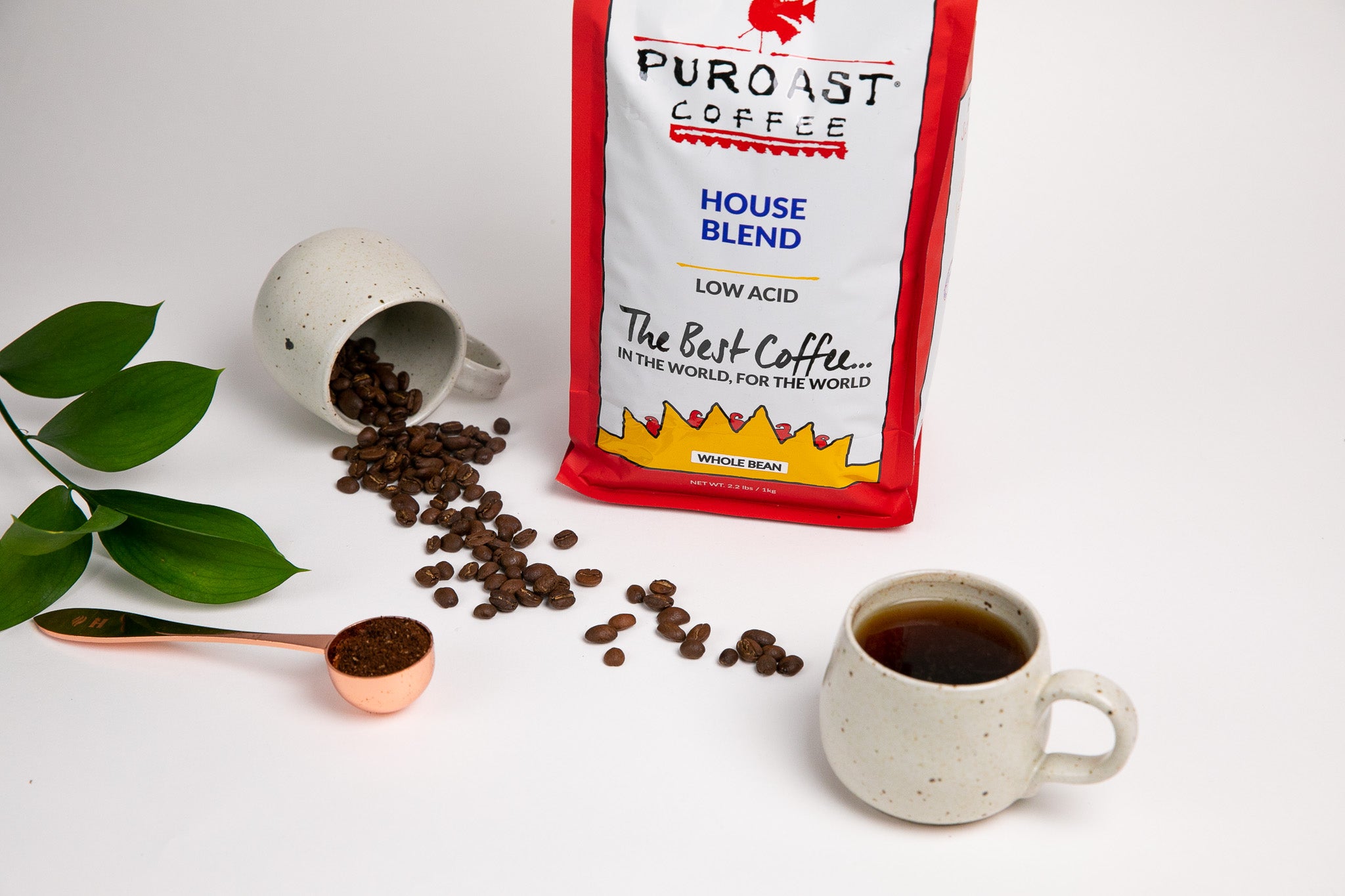
House Blend: Smooth, balanced, medium body. Notes of caramel and mild chocolate. The everyday cup that works for all palates.
-
Ugandan Single Origin: Puroast's most select bean. Complex, bright, and nuanced -- a single origin from high-altitude Uganda. The traditional roasting process reveals fruit and honey notes with no bitterness.
-
Dark French Roast: Bold, rich, and deep -- but without the harsh bitterness of flash-roasted dark roasts. Notes of dark chocolate and caramel.
-
Italian Espresso Roast: Intense, full-bodied, low-acid espresso. The antioxidant richness makes the crema smooth and the extraction clean.
-
Mocha Java: The world's oldest blend, roasted the right way. Chocolate and fruit interplay without bitterness.

House Blend Pods 24ct
K-Cup - Single Serve - 24ct
Shop Now

French Roast Pods 24ct
K-Cup - Single Serve - 24ct - Bold
Shop Now

House Blend Decaf
Decaf - Ground - 2.5 LB
Shop Now
Frequently Asked Questions
How does roasting affect coffee acidity?
Roasting determines coffee acidity by controlling how dichloroquinic acids are handled during the heat process. Flash roasting preserves and concentrates these acids. Traditional roasting -- the process Puroast uses -- converts them into phenolic antioxidants, permanently reducing acidity and increasing antioxidant content simultaneously.
Does darker roasting produce lower acid coffee?
Not with flash roasting. A 2024 NC A&T State University study tested multiple dark roast brands claiming to be low acid and found they all failed -- testing as acidic as or more acidic than regular commercial coffee. Only Puroast passed. Roast process -- not roast darkness -- determines acidity.
What is the Maillard reaction and how does it affect coffee flavor?
The Maillard reaction is a chemical reaction between amino acids and sugars that produces the brown color, roasted aromas, and complex flavors in coffee. In traditional roasting, the slower, lower-heat Maillard process allows more complete conversion of bitter acids into flavor-positive compounds -- producing a sweeter, more complex cup with less retained bitterness.
What makes Puroast's roasting process different from other brands?
Puroast uses a patented traditional roasting process -- lower heat, longer time -- that converts dichloroquinic acids into antioxidants rather than preserving them. This process was developed by Puroast's founder Kerry Sachs in the Venezuelan Andes, brought to California in the early 1990s, and is now protected by a United States patent. Independently verified by UC Davis and NC A&T. No other commercial brand uses this process.
Why do different roast levels taste different?
Roast level determines how much of the bean's origin character is preserved versus how much roasting character develops. Lighter roasts retain more origin fruit notes; darker roasts develop more caramel, chocolate, and smoky depth. But traditional roasting eliminates bitterness across all roast levels -- so all Puroast roasts share the same smooth, low acid foundation while varying in flavor character.
Sources:
1. Shibamoto, T. et al. "Antioxidative and Anti-Inflammatory Activities of Coffee Brews." Journal of Agricultural and Food Chemistry, 2008. PubMed
2. NC A&T State University independent low acid coffee verification study (2024). NewsFileCorp
3. Perrone, D. et al. "Phenolic acids and melanoidins in coffee." ACS Journal of Agricultural and Food Chemistry, 2012. ACS Publications
4. Bytof, G. et al. "Roasting chemistry and coffee antioxidants." PubMed Central
Medical Disclaimer: The information in this article is intended for educational and informational purposes only and is not a substitute for professional medical advice, diagnosis, or treatment. If you experience acid reflux, GERD, heartburn, or any digestive condition, please consult a qualified healthcare provider before making dietary changes.