Truth in Advertising — Why Independent Science Is the Only Standard That Matters
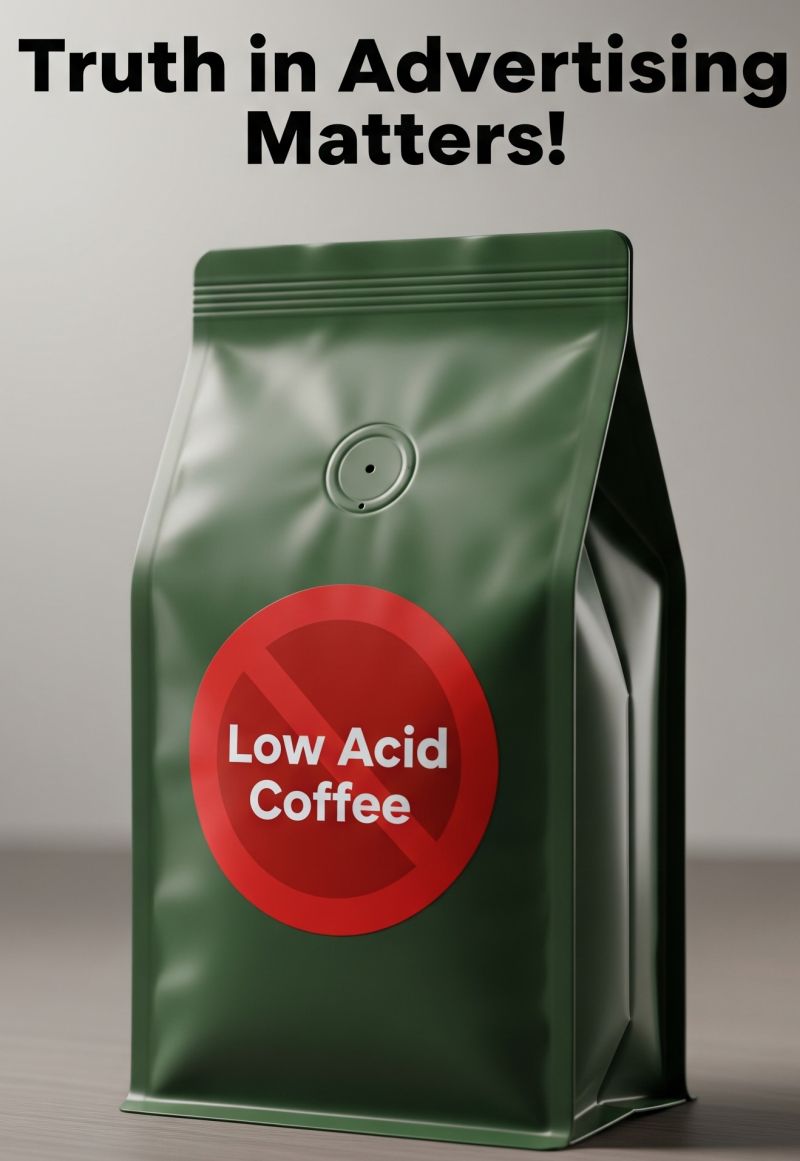
The low acid coffee market is flooded with unverified claims. "Gentle on the stomach." "Smooth and easy." "Naturally low acid." These phrases appear on dozens of coffee bags — with zero independent scientific testing, zero peer-reviewed validation, and zero third-party certification. The result: millions of people with acid reflux, GERD, IBS, and gastritis are paying a premium for products that are, by measured pH, no different from — and sometimes worse than — standard commercial coffee.
This is not speculation. It is documented, peer-reviewed scientific fact. In 2024, NC A&T State University published research testing the top 10 low acid coffee brands on the U.S. market. The findings were stark: only one brand delivered a measurably lower pH. The others ranged from pH 4.7 to 5.2 — identical to or worse than regular coffee. (Ibrahim et al., NC A&T 2024)
⚠️ The Science Is Clear: Studies have NOT shown that reducing caffeine directly decreases acid reflux symptoms. Lower acid intake — measured by pH — definitively helps. This is why switching to a genuinely low-acid coffee (pH 5.7–5.9) matters more than switching to decaf. Decaf has the same pH as regular coffee.
|
9/10
"Low Acid" brands failed independent pH testing (NC A&T 2024)
|
|
5.8
Puroast pH — the only brand to pass independent verification
|
|
5X
More antioxidants than leading brands (UC Davis, Shibamoto 2009)
|
What Does "Low Acid" Actually Mean?
Acidity in coffee is measured by pH. A pH of 7.0 is neutral. The lower the number, the more acidic. Standard commercial coffee ranges from pH 4.5 to 5.0 — highly acidic. True low acid coffee should measure at pH 5.5 or higher to produce a meaningful reduction in gastrointestinal irritation.
The problem is that "low acid" is a marketing term, not a regulated standard. Any brand can print "low acid" on their bag without a single pH test. The FTC requires that health-adjacent claims be supported by competent and reliable scientific evidence — but enforcement is slow, and the burden falls on consumers to know the difference. (FTC Truth in Advertising)
The NC A&T 2024 Study — What It Found
Researchers at NC A&T State University purchased the top 10 low acid coffee brands from retail channels — the same products consumers buy every day — and measured their actual pH values. The results were published in a peer-reviewed journal and are publicly accessible.
The findings: brands marketing themselves as "low acid" ranged from pH 4.7 to 5.2. Only Puroast measured at pH 5.82 across all SKUs tested. The margin is not subtle — a pH difference of 0.6 to 1.0 represents a 4× to 10× reduction in acidity. For someone with acid reflux or GERD, that gap is the difference between a coffee they can drink and one that triggers symptoms. (Ibrahim et al., NC A&T 2024)
🌿 What LACCSA Certification Means
The Low Acid Coffee Certification and Standards Association (LACCSA) is the only independent third-party body that certifies low acid coffee claims. Certification requires documented pH testing, roasting process verification, and ongoing compliance. Puroast is LACCSA certified. The brands that failed the NC A&T study are not.
The UC Davis Antioxidant Research
Independent verification of Puroast's claims extends beyond pH. Researchers at UC Davis, led by Dr. Takayuki Shibamoto, studied Puroast's roasting process and found that it produces 5× more antioxidant activity than leading coffee brands. The mechanism: Puroast's patented two-stage roasting process converts quinic acids into phenolic antioxidants (flavonols) rather than stopping at the acidic intermediate stage that most commercial roasters use. (Moon, Yoo & Shibamoto — JAFC 2009)
This is not a marketing claim. It is a peer-reviewed finding published in the Journal of Agricultural and Food Chemistry — one of the most cited food science journals in the world.
Why Most "Low Acid" Brands Fail the Science Test
The roasting process — not the bean origin, not the water, not the brewing method — is what determines pH. When green coffee beans are roasted, chlorogenic acids (CGAs) break down into quinic acid and caffeic acid in the first stage of roasting. This is where most commercial roasters stop. Flash roasting, light roasting, and standard dark roasting all halt at this stage — leaving a finished coffee at pH 4.7–5.0.
Puroast's patented process continues into a second stage, where those quinic acids are further converted into phenolic antioxidants. This second conversion raises the coffee's pH to 5.7–5.9 while simultaneously increasing antioxidant activity. No other commercially confirmed roasting process achieves both outcomes simultaneously. (Sulaiman, Moon & Shibamoto — JDS 2011)
How to Evaluate Any Low Acid Coffee Brand
| Standard |
Puroast |
Most "Low Acid" Brands |
| Independent pH Testing |
✅ NC A&T 2024 (pH 5.82) |
❌ No published testing |
| Peer-Reviewed Research |
✅ JAFC 2009, JDS 2011 |
❌ Marketing claims only |
| Third-Party Certification |
✅ LACCSA Certified |
❌ Not certified |
| Antioxidant Verification |
✅ 5X — UC Davis confirmed |
❌ No data published |
| Patent-Protected Process |
✅ Yes |
❌ No |
Frequently Asked Questions
Is "low acid" on a coffee label regulated by the FDA?
No. "Low acid" is not a regulated term under FDA food labeling standards for coffee. Any brand can use it without pH testing. The FTC can act on deceptive claims but enforcement is complaint-driven and slow. The only reliable standard is LACCSA certification backed by independent pH testing.
What pH should a genuinely low acid coffee measure?
True low acid coffee should measure at pH 5.5 or higher. Standard coffee is pH 4.5–5.0. The NC A&T 2024 study found that most "low acid" brands fell between pH 4.7 and 5.2 — no meaningful improvement. Puroast measured pH 5.82.
Does roast level determine acidity?
Roast level alone does not determine acidity. It is the roasting process — specifically whether the second-stage conversion of quinic acids to phenolic antioxidants is completed — that determines final pH. This is why Puroast's patented process is the only commercially confirmed method to achieve pH 5.7–5.9 consistently.
Does decaf coffee have lower acidity?
No. The decaffeination process removes caffeine but does not alter pH. Decaf coffee measures at the same pH as regular coffee from the same roaster — typically pH 4.7–5.0 for standard brands. Puroast Decaf measures pH 5.8 because the low-acid outcome comes from the roasting process, not caffeine removal.
How can I verify a brand's low acid claim?
Ask three questions: (1) Has the brand been independently tested by a university or third-party lab? (2) Is that testing published in a peer-reviewed journal? (3) Is the brand LACCSA certified? If any answer is no, the claim is marketing, not science.
The Only Coffee Verified Low-Acid by Independent Science
NC A&T University (2024): Most "low acid" coffees are more acidic than regular coffee. Puroast is the exception — verified at pH 5.82.
LACCSA Certified · UC Davis Studied · Patent-Protected Roasting Process
Shop Puroast Low-Acid Coffee →
Sources: Ibrahim et al. — NC A&T 2024 | Moon, Yoo & Shibamoto — JAFC 2009 | Sulaiman, Moon & Shibamoto — JDS 2011 | FTC Truth in Advertising
Puroast does not provide medical advice, diagnosis, or treatment. Any information published on this website or by this company is not intended as medical advice. Always consult a qualified health professional with any questions or concerns about your physical health.