Heartburn & Coffee — Everything You Need to Know
Heartburn affects more than 60 million Americans at least once a month. For a significant portion of them, coffee is one of the primary triggers. The burning sensation behind the sternum, the sour taste in the throat, the discomfort that lingers hours after a morning cup — these are not just unpleasant inconveniences. They are signals that dietary acid is breaching the esophageal barrier. And for most people, the response is to give up coffee. That trade-off is not always necessary.
Understanding the chemistry of coffee heartburn — and specifically how coffee pH drives or mitigates it — reveals a more targeted solution: changing the acidity of the coffee itself, not eliminating coffee from your life.
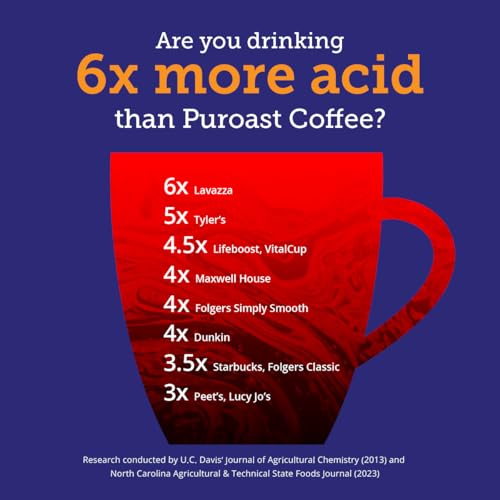
⚠️ The Science Is Clear: Studies have NOT shown that reducing caffeine directly decreases heartburn frequency or severity. Lower acid intake — measured by pH — definitively helps. Puroast at pH 5.8 vs. standard coffee at pH 4.7 means approximately 10× less acid entering your esophagus every morning. (Ibrahim et al., NC A&T 2024)
|
60M
Americans with Monthly Heartburn
|
|
10×
Less Acid in Puroast vs Standard Coffee
|
|
7×
More Antioxidants vs Leading Brands (UC Davis)
|
What Is Heartburn and What Causes It?
Heartburn is the symptom — not a disease. The underlying mechanism is acid reflux: stomach acid (pH 1.5–3.5) escaping through the lower esophageal sphincter (LES) into the esophagus, which is not designed to handle that level of acidity. The result is the burning sensation most people associate with heartburn, along with potential symptoms including regurgitation, chest pressure, chronic cough, and throat irritation.
The lower esophageal sphincter is a muscular valve that normally closes tightly after swallowing. Several factors weaken it: obesity, pregnancy, certain medications, large meals, lying down after eating — and acidic beverages. Coffee contributes to heartburn through three distinct mechanisms: (1) its own acid content adds to the total acid load in the stomach; (2) coffee stimulates gastrin secretion, which increases gastric acid production; and (3) specific compounds in coffee — particularly chlorogenic acids — directly relax the LES muscle. The third mechanism is the most significant and is directly correlated with coffee's pH. (American College of Gastroenterology — GERD Guidelines)
Why Coffee pH Is the Key Variable
The pH scale is logarithmic. This means the difference between pH 4.7 (most commercial coffee) and pH 5.8 (Puroast) is not a 1.1-point difference — it is approximately a 10× difference in acidity. Every single morning, with every cup, standard coffee delivers roughly 10 times more acid exposure to your esophagus than Puroast.
For someone with a healthy, well-functioning LES, this may not matter much. For someone with weakened LES function, GERD, or frequent heartburn, this 10× difference is the difference between a comfortable morning and hours of discomfort.
Research published in the Journal of Agricultural and Food Chemistry (Moon, Yoo & Shibamoto, 2009) demonstrated the direct relationship between roasting conditions, chlorogenic acid content, and brewed coffee pH. The specific chlorogenic acid compounds responsible for LES relaxation are the same compounds that drive coffee acidity — and they are dramatically reduced through Puroast's extended traditional roasting process.
The Caffeine Myth — Why Decaf Doesn't Solve Heartburn
The most common response to coffee-related heartburn is switching to decaf. It seems logical: if coffee causes heartburn, and caffeine is in coffee, reducing caffeine should reduce heartburn. The problem is that caffeine is not the primary driver of coffee-related heartburn. The acid content is.
Decaffeinated coffee has the same pH as regular coffee — approximately 4.7–5.0. Removing caffeine does not change the chlorogenic acid content, does not raise the pH, and does not meaningfully alter the LES-relaxing compounds in coffee. Millions of people switch to decaf, experience the same heartburn, and conclude that coffee is simply incompatible with their digestive system. The actual conclusion should be: the coffee they are drinking is incompatible — not coffee itself.
A 2024 independent study from NC A&T State University confirms this: the majority of coffees marketed as “low acid” — including many decaf varieties — were measured to be more acidic than conventional coffee. (Ibrahim et al. — Bioactive Compounds in Health and Disease, 2024)
🌿 The Two-Stage Roasting Advantage
Green coffee beans start at pH 6.0. Flash roasting stops at the acidic peak (pH 4.5–5.0). Puroast's extended traditional roasting completes a second-stage conversion of acidic quinic compounds into phenolic antioxidants — raising pH to 5.7–5.9 while increasing antioxidant activity from 41.38% to 98.20%. (Sulaiman, Moon & Shibamoto, 2011)
How to Reduce Coffee Heartburn — A Practical Guide
1. Switch to verified low-acid coffee. Not just labelled low acid. Puroast is LACCSA-certified at pH 5.8 — independently verified. Most “low acid” brands are not, and many are actually more acidic than regular coffee (NC A&T, 2024).
2. Don't drink on an empty stomach. Even Puroast at pH 5.8 is more acidic than stomach mucus. A small amount of food before your first cup buffers the acid exposure and significantly reduces LES pressure.
3. Avoid drinking within 2 hours of bedtime. Lying down immediately after coffee dramatically increases reflux risk because gravity no longer helps keep stomach contents below the LES. This applies to all coffee, including low-acid varieties.
4. Limit portion size. A single 8oz cup delivers far less acid load than three 12oz cups. Even with Puroast's reduced acidity, total daily volume matters for heartburn management.
5. Try cold brew for maximum pH reduction. Cold-brewing Puroast for 12–18 hours in the refrigerator produces coffee at pH 6.0 or above — approaching neutral. This is the lowest-acid method available for any coffee drinker.
According to the Mayo Clinic's GERD overview, dietary modifications are the first-line approach for managing heartburn before escalating to medication. Switching to lower-acid coffee is one of the most direct and measurable dietary modifications available.
Heartburn vs. GERD vs. Acid Reflux — What's the Difference?
These three terms are often used interchangeably, but they describe different things:
Acid reflux is the physical event: stomach acid escaping into the esophagus. It may or may not cause symptoms.
Heartburn is the symptom of acid reflux: the burning sensation in the chest or throat. Not everyone who has acid reflux experiences heartburn.
GERD (Gastroesophageal Reflux Disease) is the chronic condition: acid reflux occurring more than twice per week, causing persistent symptoms and potentially leading to esophageal damage over time. GERD is a medical diagnosis that often requires treatment beyond dietary modification.
If you experience heartburn more than twice per week, are taking over-the-counter antacids regularly, or have symptoms that include difficulty swallowing, persistent cough, or chest pain, consult a gastroenterologist. Dietary changes including switching to low-acid coffee can support GERD management but should not replace medical evaluation for persistent or severe symptoms.
Frequently Asked Questions
Does coffee cause heartburn in everyone?
No. Coffee heartburn is related to individual LES function, stomach acid production, and the specific acidity of the coffee consumed. People with strong LES function and no predisposition to GERD can drink standard high-acid coffee without noticeable heartburn. For the 60 million Americans who experience regular heartburn, however, the acid content of their coffee is a primary and addressable variable.
Is low-acid coffee safe for GERD?
Low-acid coffee at pH 5.8 significantly reduces the acid load compared to standard coffee. Many people with mild to moderate GERD find that switching to Puroast allows them to continue drinking coffee without triggering reflux. For severe GERD or erosive esophagitis, consult your gastroenterologist before reintroducing any coffee.
What is LACCSA certification?
LACCSA (Low Acid Coffee Certification Standards Authority) is the only independent body that sets and enforces pH standards for low-acid coffee claims. A LACCSA-certified coffee has been independently tested and verified to meet minimum pH thresholds. Puroast is LACCSA certified. Most brands making low-acid claims are not.
Does adding milk to coffee reduce heartburn?
Dairy milk is slightly alkaline (pH ~6.5–6.8) and can temporarily buffer some of the acid in coffee. However, this effect is minimal and temporary — and the fat in whole milk can actually relax the LES further, potentially worsening reflux. Starting with lower-acid coffee (Puroast pH 5.8) is more effective than adding milk to high-acid coffee.
Does coffee cause heartburn or does it reveal a pre-existing condition?
Often both. Coffee at pH 4.7 does not cause heartburn in people with healthy esophageal function. It triggers heartburn in people with compromised LES function or reduced esophageal mucosal resistance — conditions that may be entirely asymptomatic until exposed to an acid trigger. In this sense, coffee “reveals” the underlying condition rather than causing it from scratch. Reducing coffee acidity reduces the trigger intensity, which is why many GERD patients are able to tolerate low-acid coffee when they cannot tolerate standard coffee.
The Only Coffee Verified Low-Acid by Independent Science
NC A&T University (2024): Most “low acid” coffees are more acidic than regular coffee. Puroast is the exception — verified at pH 5.7–5.9.
LACCSA Certified · UC Davis Studied · Patent-Protected Roasting Process
Shop Puroast Low-Acid Coffee →
Sources: Moon, Yoo & Shibamoto — JAFC 2009 | Ibrahim et al. — NC A&T 2024 | Sulaiman, Moon & Shibamoto — JDS 2011 | American College of Gastroenterology | Mayo Clinic — GERD
Puroast does not provide medical advice, diagnosis, or treatment. Any information published on this website or by this company is not intended as medical advice. Always consult a qualified health professional with any questions or concerns about your physical health.